Affiliate Disclosure: As an Amazon Associate, we earn from qualifying purchases. Clicking our links costs you nothing extra and helps us keep reviewing products for free.
Wooden vs. Metal Dog Crate Furniture: Which End-Table Kennel Should You Buy in 2026? AECOJOY
Market context: 67% of U.S. households own a pet, according to the American Pet Products Association.
The pet industry is the market industry associated with companion animals. It includes things that are associated with the production, consumption and cultural activities linked to the market.
By Best Pet Picks Daily • September 03, 2026 • Contains affiliate links
The furniture-style dog crate has quietly become the default choice for anyone who doesn't want a black wire box parked in the living room. But the category has split into two very different camps: solid wood (or wood-composite) end tables with slatted doors, and powder-coated metal crates that lean modern and minimalist. They cost roughly the same, they both hold a dog, and they behave completely differently once a real animal is inside.
This comparison puts AECOJOY up against three of the most commonly cross-shopped alternatives: Casual Home (the long-standing budget wooden crate), New Age Pet ecoFLEX Habitat 'n' Home (the recycled-composite premium option), and Diggs Revol (the design-award metal crate that costs more than most nightstands). We also touch on Frisco, Chewy's house brand, because it undercuts almost everyone on price.
Before purchasing a wooden dog crate furniture piece, verify that all wood surfaces are sealed or treated to withstand moisture, accidents, and chewing, as untreated wood can splinter, absorb odors, and harbor bacteria over time. Metal crates typically require checking that the coating is rust-resistant and the joints are welded securely, especially if the furniture will be placed in humid environments or outdoors.
The honest short version: none of these is the best crate for every dog. A 90-lb separation-anxiety chewer and a 12-lb senior Shih Tzu need completely different products, and the marketing photos won't tell you that. Below is what actually differs — materials, joinery, door hardware, weight limits and price — so you can pick on use case rather than aesthetics.
AECOJOY — Best value in solid-wood end-table crates
AECOJOY sits in the sweet spot most shoppers are actually looking for: a genuine wooden furniture crate, usually in the $110–$200 range depending on size, with a flat tabletop rated to hold a lamp, books or a TV. The construction is typically MDF/particleboard panels with a solid wood or wood-veneer frame and vertical slats, plus a double-latch door on the medium and large sizes. Compared to the ultra-budget end of the market, the things AECOJOY tends to get right are the tabletop load rating (many competing units warn against putting anything heavier than a coffee cup on top), the removable door design that lets you re-hinge for left or right opening, and the finish quality — the espresso and rustic-oak finishes look closer to real furniture than the plasticky laminates you see under $100. AECOJOY also runs a broader pet catalog, so if you're building out a matching setup — their pet beds, outdoor kennels and dog houses — you can keep finishes consistent. The trade-off is the same as every wood crate: it is not a containment solution for a determined escape artist. Slats are wood, and a serious chewer will find the corner of the door frame within a week.
Casual Home Wooden Pet Crate End Table — the cheapest real-wood option
Casual Home has been the default Amazon answer to "wooden dog crate" for close to a decade, and it's frequently $20–$40 cheaper than AECOJOY at comparable sizes, often landing around $90–$150. It's made largely of solid pine with a stain finish, which some buyers prefer over composite panels, and the small size fits in tight apartment corners better than most. Where it loses ground is hardware and tolerance: the single sliding barrel-bolt latch is easier for a clever dog to nose open, assembly holes are notoriously misaligned on some batches, and the slats are thinner than what AECOJOY and New Age Pet use. The tabletop is also less generous — usable, but the overhang is minimal and it feels more like a crate with a lid than a piece of furniture. For a calm, crate-trained small dog and a tight budget, it's genuinely fine. For anything over 40 lbs, most owners report it flexes.
New Age Pet ecoFLEX Habitat 'n' Home — the premium, chew-resistant composite
New Age Pet is the upgrade pick and priced like it: typically $250–$450 depending on size. The ecoFLEX material is a recycled plastic-and-wood composite that won't warp, absorb urine odor, or delaminate the way MDF does when a dog has an accident — that alone justifies the price for puppies and seniors. It's also markedly more chew-resistant than pine or MDF, and the units are made in the USA with a longer warranty. The downsides are real, though: ecoFLEX looks slightly synthetic up close, the color range is limited to white, gray, russet and espresso, and the pieces are heavy — a large model can push 90 lbs assembled, which makes moving it a two-person job. If your dog has ever had a bladder accident in a crate, this is the one you buy. If not, you're paying roughly double AECOJOY's price for durability you may never need.
Diggs Revol — the metal argument
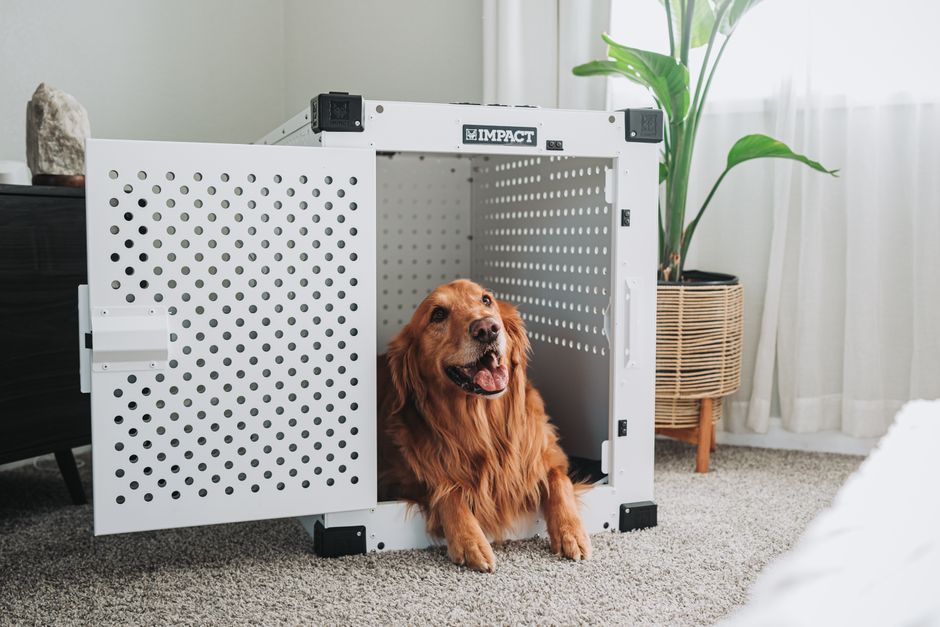
Diggs Revol is the flagship of the metal camp at roughly $299–$450. It's not an end table; it's a diamond-mesh steel crate with a rounded silhouette, a garage-style side door, a top hatch for reaching in without opening the front, a puppy divider, and wheels for one-hand repositioning. It collapses in about 10 seconds for travel and has crash-test credentials the wooden crates simply can't claim. If containment security is your priority — anxious dogs, escape artists, crate training a new puppy — metal wins outright, and Revol is the best-executed version of it. What you give up is furniture function: there's no flat tabletop, no closed sides for den-like privacy, and it still reads as "dog equipment" in a living room. Airflow and visibility are better than any wood crate, which is good for hot climates and bad for dogs who settle better when they can't see the room.
Frisco Wooden End Table Dog Crate — the Chewy alternative
Worth naming because it's the most common price competitor to AECOJOY: Frisco's wooden end-table crate usually runs $130–$220, comes in a couple of finishes, and offers the useful advantage of Chewy's return policy and customer service, which is materially better than most third-party sellers when a panel arrives cracked. Build quality is broadly comparable to AECOJOY — same MDF-and-frame approach — though the tabletop weight ratings are typically lower and the door latch is simpler. Choose Frisco if you value the returns safety net; choose AECOJOY if you want the stronger tabletop and more finish options for the money.
Wood vs. metal: how to actually decide
Ask two questions. First: has your dog ever escaped, bent, or chewed through a crate? If yes, buy metal (Revol) or composite (ecoFLEX) and stop reading. Second: does the crate need to earn its floor space as furniture? If yes, wood wins, because a metal crate will never hold a lamp. Most adult, crate-trained dogs in normal households fall into the second group, which is why the wooden end-table category keeps growing — and why the price differences between AECOJOY, Casual Home and Frisco matter more than the wood-versus-metal debate itself.
Pros & Cons
Pros
✓ Higher rated tabletop load capacity than Casual Home and Frisco's comparable end-table crates, so it actually works as a nightstand or lamp table
✓ Costs roughly half of a New Age Pet ecoFLEX unit and a third of a Diggs Revol at similar interior dimensions
✓ Reversible/removable door and double-latch hardware on larger sizes — a step up from Casual Home's single barrel bolt
✓ Broader matching pet catalog (beds, outdoor kennels, dog houses) so finishes can be coordinated across a room or yard
Cons
✗ MDF and veneer panels absorb moisture and odor far worse than New Age Pet's ecoFLEX composite — a single accident can permanently mark the interior
✗ No meaningful chew or escape resistance compared to a Diggs Revol; wooden slats and frame corners are vulnerable to anxious or destructive dogs
Our Verdict
There's no single winner here, only clear use cases. Buy AECOJOY if you have a calm, already crate-trained dog and want the best-looking, best-functioning end table for the money — it beats Casual Home on hardware and tabletop strength, matches Frisco on build, and saves you $150+ versus the premium options. Buy New Age Pet ecoFLEX if you're crate-training a puppy or housing a senior with bladder issues; the odor-proof, warp-proof composite is worth the roughly double price and you'll only buy it once. Buy the Diggs Revol if your dog has ever escaped a crate, if you travel with them, or if you need something that folds and rolls — no wooden crate competes on containment or portability. Buy Casual Home only if budget is the binding constraint and your dog is under about 40 lbs. Match the crate to the dog's behavior first and the room's decor second, and any of these four will serve you for years.
Are wooden dog crate end tables strong enough to hold a lamp or TV?
It depends entirely on the model. AECOJOY and New Age Pet units generally publish tabletop weight ratings in the 40–100 lb range depending on size, which comfortably handles a lamp, books or a small TV. Cheaper crates like some Casual Home models are best limited to light decor — the panels are thinner and the top has less structural support underneath.
Will my dog chew through a wooden crate?
A determined chewer will, yes. Wood and MDF crates from AECOJOY, Casual Home and Frisco are containment for dogs that are already comfortable being crated, not for anxious or destructive dogs. If your dog has ever chewed, dug or escaped, go with a Diggs Revol metal crate or New Age Pet's ecoFLEX composite, which is significantly more chew-resistant than pine.
How do I clean a wooden crate after an accident?
Fast and thoroughly. Blot immediately, clean with an enzymatic cleaner, and dry completely — MDF and veneer will swell and hold odor if moisture sits. Using a washable waterproof crate pad is essentially mandatory with a wooden crate. If accidents are likely, the ecoFLEX composite is the more sensible material because it's non-porous and can be hosed down.
What size end-table crate should I buy?
Measure your dog standing, from nose to tail base and floor to top of head, then add 2–4 inches to each dimension. Don't oversize a crate for a puppy you're house-training — extra space encourages them to soil one end. Note that furniture crates lose interior height to the tabletop frame, so check internal, not external, dimensions before ordering.
Our team researches and tests hundreds of pet products every month so you don't have to. Every recommendation is based on real research: customer reviews, expert opinions, and value for money. Learn more about us →
This post contains affiliate links. We may earn a commission if you purchase through our links at no extra cost to you.